
Renal Dosing Calculator & Risk Assessor
Patient Parameters
Calculation Results
Cockcroft-GaultEstimated Creatinine Clearance
Calculated Value
0 mL/min
Gender Adjustment
None
Category
Description goes here.
Clinical Implications
Ready to Calculate
Enter patient parameters on the left to estimate Creatinine Clearance and view renal dosing recommendations.
Imagine prescribing a life-saving antibiotic to a patient with chronic kidney disease, only to watch them suffer from severe neurological toxicity or treatment failure. It’s a scenario that happens far too often in hospitals across the United States. The core problem isn’t usually the drug itself; it’s the dose. When kidneys fail to filter waste efficiently, medications linger in the body, accumulating to dangerous levels. Conversely, underdosing can leave infections unchecked, leading to sepsis or death. This delicate balance is known as renal dosing, which is the systematic adjustment of medication doses based on kidney function to prevent toxicity while maintaining efficacy. For clinicians, mastering this process is not just a best practice-it is a critical safety requirement.
The stakes are incredibly high. According to the Kidney Disease: Improving Global Outcomes (KDIGO) organization, approximately 37 million Americans live with chronic kidney disease (CKD), affecting 15% of the adult population. In these patients, standard antibiotic doses can become toxic. A 2019 review in *Clinical Infectious Diseases* revealed that inappropriate dosing increases mortality risk by 27.1% in pneumonia patients and 20.0% in those with urinary tract infections. Proper renal dosing reduces adverse drug events by 43%, making it one of the most impactful interventions in infectious disease management.
Calculating Kidney Function: The Foundation of Dosing
Before you adjust a single milligram of an antibiotic, you must accurately assess how well the patient’s kidneys are working. The gold standard for this calculation remains the Cockcroft-Gault equation, developed in 1976 and still used today to estimate creatinine clearance (CrCl). While newer equations like the Modification of Diet in Renal Disease (MDRD) exist, most antibiotic labeling and clinical guidelines rely on CrCl calculated via Cockcroft-Gault because it correlates better with drug clearance in many contexts.
The formula looks like this:
CrCl = [(140 - age) × weight (kg)] / [72 × serum creatinine (mg/dL)]If the patient is female, multiply the result by 0.85. Simple enough in theory, but fraught with error in practice. A 2023 survey published in the *Journal of Hospital Medicine* found that 63% of physicians incorrectly estimated CrCl using this equation. A common pitfall? Failing to use ideal body weight for obese patients. If you plug in total body weight for a morbidly obese patient, you will overestimate their kidney function, potentially leading to toxic overdosing. Always verify whether the protocol calls for actual, ideal, or adjusted body weight before calculating.
Standard Dosing Thresholds and Classifications
Once you have the CrCl number, you need to know what it means for dosing. Most institutional guidelines, including those from Northwestern Medicine and the University of Nebraska Medical Center (UNMC), classify renal function into four distinct categories. These thresholds determine whether you give a full dose, reduce the maintenance dose, or extend the dosing interval.
| Category | CrCl Range (mL/min) | Clinical Implication |
|---|---|---|
| Normal | >50 | Standard dosing applies |
| Mild Impairment | 31-50 | Monitor closely; some drugs require no change |
| Moderate Impairment | 10-30 | Dose reduction or interval extension required for most renally cleared drugs |
| Severe Impairment / Anephria | <10 or Hemodialysis | Significant dose reduction; post-dialysis supplementation may be needed |
It is crucial to note that about 60% of commonly used antibiotics require some form of renal adjustment. However, not all drugs behave the same way. Some, like ceftriaxone, have dual elimination pathways (biliary and renal), meaning no dose adjustment is typically needed regardless of CrCl. Others, such as vancomycin, have narrow therapeutic indices where precise monitoring is essential to avoid nephrotoxicity and ototoxicity.
Navigating Conflicting Guidelines
If you have ever tried to find the right dose for a specific antibiotic, you might have noticed that different sources give different answers. This inconsistency is a major source of clinical confusion. For example, when looking at ampicillin/sulbactam, the UNMC guidelines recommend reducing the dose to 2 g every 24 hours for patients with a CrCl <15 mL/min. However, some other institutional protocols suggest extending the interval to every 48 hours. Similarly, for clarithromycin, UNMC suggests a 24-hour interval for CrCl <30 mL/min, while Northwestern Medicine extends this recommendation to any CrCl below 50 mL/min.
This variation creates a real-world dilemma. A 2023 analysis noted that 41% of hospital pharmacists struggle with applying these inconsistent recommendations. To mitigate this risk, many academic medical centers (72%) standardize on KDIGO recommendations or establish internal pharmacy-led protocols. The key takeaway? Don’t guess. Adopt a single, trusted guideline source within your institution and stick to it. Consistency saves lives.
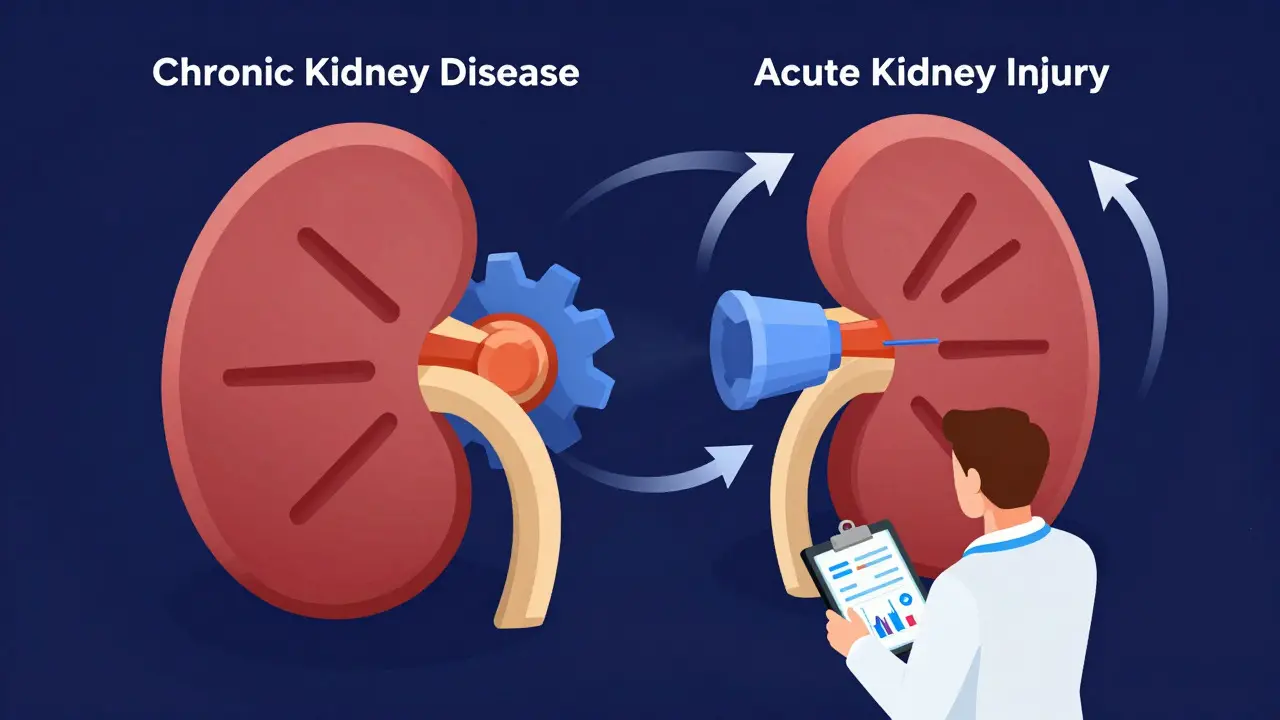
The Acute vs. Chronic Kidney Disease Dilemma
One of the most debated topics in renal dosing is the difference between treating acute kidney injury (AKI) and chronic kidney disease (CKD). Current guidelines were largely developed based on data from stable CKD patients. But AKI is dynamic. Kidney function can improve rapidly, sometimes within 48 hours. Dr. Jason Roberts, lead author of the 2019 *Clinical Infectious Diseases* review, argues that we are "jumping the gun" by reducing doses too early in AKI patients.
Here’s why this matters: if you reduce the dose of a wide-therapeutic-index antibiotic like cefazolin in a patient with transient AKI, you risk underdosing. Studies show this increases treatment failure risk by 34%. On the flip side, if the patient’s kidneys recover quickly and you haven’t adjusted back up, you risk toxicity. The FDA’s 2024 draft guidance now emphasizes the importance of the first 48 hours of therapy in AKI, suggesting that unnecessary dose reductions may compromise outcomes. The emerging consensus is to monitor serum levels closely and adjust dynamically rather than relying on static CrCl calculations alone.

Special Populations: Dialysis and Augmented Clearance
Kidney disease isn’t just about low function; it’s also about extreme variability. Two special populations require unique considerations: patients on dialysis and those with augmented renal clearance.
For patients on hemodialysis, the timing of the dose relative to the dialysis session is critical. Many antibiotics are removed during dialysis. Continuous Renal Replacement Therapy (CRRT), often used in intensive care units, requires even more nuanced adjustments because the filtration rate is continuous and variable. Northwestern Medicine’s June 2025 guidance includes specific CRRT dosing for newer agents like ceftazidime-avibactam, a detail missing from older guidelines.
On the opposite end of the spectrum is augmented renal clearance (ARC), defined as a CrCl >130 mL/min. This is common in young, critically ill patients, burn victims, or those with sepsis. Their kidneys filter drugs so fast that standard doses become subtherapeutic. For instance, UNMC recommends increasing piperacillin/tazobactam to 2 g IV every 4 hours in ARC patients. Ignoring ARC can lead to silent treatment failures, especially against resistant organisms.
Practical Steps to Prevent Errors
How do you implement this safely in a busy clinical environment? Here are three evidence-based strategies:
- Automate Calculations: Rely on electronic health record (EHR) alerts. As of 2024, 89% of U.S. hospitals have implemented EHR alerts for renal dosing. These systems automatically calculate CrCl and flag discrepancies between prescribed and recommended doses.
- Pharmacist-Led Services: Involve clinical pharmacists early. A 2021 study in *Clinical Therapeutics* showed that pharmacist-led dose adjustment services reduced antibiotic-related adverse events by 37%. They provide a vital second pair of eyes on complex cases.
- Therapeutic Drug Monitoring (TDM): For drugs with narrow therapeutic windows like vancomycin or aminoglycosides, use TDM. Projected adoption of TDM is set to rise from 38% to 65% of academic centers by 2027. Measuring actual drug levels in the blood provides the most accurate picture of efficacy and toxicity, bypassing the limitations of CrCl estimates.
Remember, the goal is not just to avoid toxicity, but to ensure the drug actually works. Underdosing is just as dangerous as overdosing. By understanding the nuances of renal function, respecting the differences between acute and chronic conditions, and leveraging technology and teamwork, you can navigate the complexities of renal dosing with confidence.
What is the most common cause of antibiotic toxicity in kidney disease?
The most common cause is failing to adjust the maintenance dose or dosing interval based on the patient's creatinine clearance (CrCl). When kidneys cannot filter drugs efficiently, antibiotics accumulate in the bloodstream, leading to neurotoxicity, nephrotoxicity, or other adverse effects.
Should I use eGFR or CrCl for antibiotic dosing?
You should generally use creatinine clearance (CrCl) calculated via the Cockcroft-Gault equation. Most antibiotic package inserts and clinical guidelines are based on CrCl, not estimated glomerular filtration rate (eGFR). Using eGFR can lead to incorrect dosing decisions because the values often differ significantly, especially in elderly or obese patients.
Do all antibiotics require renal dose adjustment?
No. Approximately 60% of commonly used antibiotics require adjustment. Drugs that are primarily eliminated by the liver or have dual elimination pathways, such as ceftriaxone, often do not require dose changes regardless of kidney function. Always check the specific drug’s excretion profile.
How does acute kidney injury (AKI) affect dosing compared to chronic kidney disease (CKD)?
AKI is dynamic, meaning kidney function can change rapidly. Standard guidelines based on stable CKD may lead to underdosing in AKI patients whose kidneys are recovering. Experts recommend avoiding premature dose reductions in AKI and using therapeutic drug monitoring to guide adjustments dynamically.
What is augmented renal clearance and why does it matter?
Augmented renal clearance (ARC) occurs when CrCl exceeds 130 mL/min, often seen in young, critically ill patients. In these cases, kidneys filter drugs faster than normal, requiring higher or more frequent doses to maintain therapeutic levels. Ignoring ARC can result in treatment failure due to subtherapeutic drug concentrations.


Comments
Christina Thygesen August 6, 2026 AT 15:38
it is so scary how easy it is to make a mistake with these doses and i always worry about my patients because one wrong calculation can mean the difference between healing and hurting them deeply
i try to double check everything but even then it feels like we are walking on thin ice sometimes
Minal Aditi August 6, 2026 AT 21:20
oh look another article pretending that math saves lives when really it is just bureaucracy dressed up as science
you people think calculating creatinine clearance makes you gods of medicine but really you are just guessing with better calculators
the real toxicity is the arrogance of thinking you know what a human body needs based on a formula from 1976
we are all just waiting for the other shoe to drop while you play doctor with numbers that mean nothing in the face of biological chaos
how delightful that you find comfort in spreadsheets while the patient suffers in silence
truly inspiring stuff if you enjoy your own delusion
Diane Nash August 7, 2026 AT 17:58
It is imperative that we acknowledge the profound responsibility placed upon clinicians to master these dosing protocols with absolute precision and unwavering dedication
The statistical evidence presented herein underscores the critical necessity of adhering to established guidelines such as those provided by KDIGO to ensure optimal patient outcomes
We must strive for excellence in our practice by continuously educating ourselves on the nuances of renal function and its impact on pharmacokinetics
Let us commit to this noble pursuit of medical accuracy and safety for the benefit of all who seek our care
Alli Crumley August 9, 2026 AT 13:11
lol you guys are still using cockcroft-gault like it is 1976 :P
the fact that 63% of physicians get it wrong shows how broken the system is
if you cannot calculate a simple equation correctly you should not be prescribing anything let alone life saving antibiotics
it is pathetic honestly
use ideal body weight or go home
simple logic escapes most of you apparently :/
Marc H August 10, 2026 AT 04:29
oh brilliant another lecture on how to not kill people with basic arithmetic
because clearly the problem was never the drugs themselves but rather our collective inability to do high school algebra
i suppose we should all burn our textbooks and start praying to the kidney gods instead
what a relief to know that my local hospital has an ehr alert that probably triggers every time someone sneezes near a computer
just fantastic
can we please move on to something more interesting like why coffee tastes bad?
Chris McQuaid August 12, 2026 AT 00:07
the issue here is that everyone treats crcl like it is a hard truth when it is really just a rough estimate at best
people forget that serum creatinine varies wildly based on muscle mass diet and hydration status
so you are building a dosing strategy on a foundation of sand
therapeutic drug monitoring is the only way to actually know what is going on in the patient
until then we are all just shooting in the dark with fancy formulas
it is a philosophical problem disguised as a clinical one
we pretend to have control over biology when we really do not
sam howard August 13, 2026 AT 16:05
stop overcomplicating it
if kidneys fail dose drops
if kidneys work fast dose goes up
why do we need 20 pages to explain that
just check the levels and adjust
simple as that
Samuel Hershberger August 14, 2026 AT 03:00
great points everyone
i think the key takeaway here is that collaboration between pharmacists and physicians is essential for safe dosing
we should encourage more pharmacist-led services in hospitals to help catch these errors before they happen
it is amazing how much better outcomes are when we work together as a team
let us keep supporting each other in providing the best care possible for our patients
every small step counts towards reducing adverse events
Mathew Stuckey August 14, 2026 AT 04:00
this is really helpful info thanks for sharing 🙌
i love learning about these details
it makes me feel more confident in my studies 😊
John Divers August 15, 2026 AT 23:47
the distinction between acute and chronic kidney disease is indeed a significant consideration in clinical practice
we must remain flexible in our approach to dosing
dynamic adjustment is preferable to static rules
Ambria St louis August 16, 2026 AT 22:26
It is absolutely vital that we consider the individual patient's unique physiology when determining antibiotic dosages!!!
One size does not fit all in medicine!!!!
We must advocate for personalized care plans that take into account factors such as age, weight, and comorbidities!!!!
This holistic approach ensures that no patient is left behind in the quest for effective treatment!!!!!
Let us embrace this complexity with open arms and dedicated minds!!!!!
Dennis Leeftink August 17, 2026 AT 10:56
most doctors are clueless about this
they just copy paste orders
no wonder patients die
basic math is hard for some people
fix the system or stop practicing
Traci Bobbitt August 18, 2026 AT 22:44
ugh finally someone says it
everyone knows ceftriaxone doesn't need adjustment but half the residents still ask
read the label
it is right there
not rocket science