
Your fingers turn white or blue when you step outside in the cold. You think it’s just the weather. Months later, your skin feels tight, like a second layer of latex is shrinking around your hands. You can’t button your shirt. This isn’t aging. It might be scleroderma, also known as systemic sclerosis, a rare but serious autoimmune connective tissue disease characterized by excessive collagen production leading to hardening of the skin and internal organs.
Scleroderma affects about 300 out of every million people globally. In the United States alone, roughly 300,000 people live with this condition, with 19,000 new diagnoses made each year. It doesn’t discriminate based on wealth, but it does favor women-about four times more women than men are diagnosed. The typical age of onset is between 30 and 50. If you’ve been told your symptoms are “just stress” or “all in your head,” you’re not alone. Patients often see an average of 3.2 different doctors over 18 months before getting the correct diagnosis.
What Is Scleroderma? Understanding the Mechanism
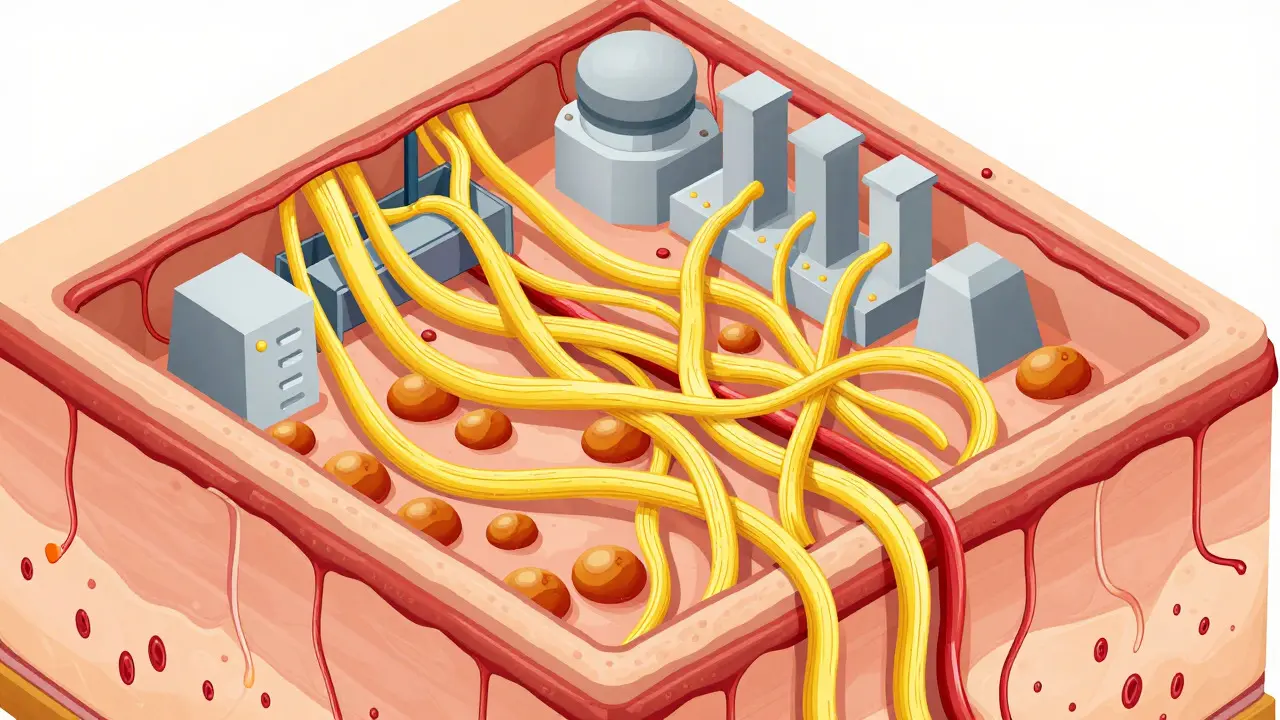
To understand scleroderma, you need to understand collagen. Collagen is the protein that gives your skin its structure and strength. Think of it as the scaffolding of your body. In a healthy person, collagen is produced, used, and recycled efficiently. In scleroderma, the immune system goes rogue. It attacks blood vessels and tissues, triggering inflammation. This inflammation signals fibroblasts (cells that make collagen) to go into overdrive. They produce too much collagen, and the body fails to break it down.
The result? Fibrosis. Tissues become thick, hard, and scarred. This process can happen in the skin, making it tight and shiny. But in systemic sclerosis, the fibrosis spreads to internal organs. Up to 90% of patients experience gastrointestinal issues. About 80% face lung complications, such as pulmonary fibrosis or pulmonary arterial hypertension. The heart is affected in 30-45% of cases, and the kidneys in 10-15%. This widespread impact is what makes scleroderma so dangerous and complex.
Localized vs. Systemic: Knowing the Difference
Not all scleroderma is the same. Doctors classify it into two main types, and knowing which one you have changes everything regarding prognosis and treatment.
| Feature | Localized Scleroderma (Morphea) | Systemic Scleroderma (Systemic Sclerosis) |
|---|---|---|
| Affected Areas | Skin only (patches or bands) | Skin, blood vessels, and internal organs |
| Organ Damage | Rare | Common (Lungs, Heart, GI Tract, Kidneys) |
| Progression | Often stabilizes or resolves over years | Chronic, progressive, potentially life-threatening |
| Antibodies | Usually negative for specific scleroderma antibodies | Positive for ANA, Anti-Scl-70, Anti-Centromere, etc. |
| Life Expectancy | Normal | Reduced depending on subtype and organ involvement |
Localized scleroderma, often called morphea, stays on the surface. It looks like hardened patches of skin. While it can be disfiguring or painful, it rarely threatens your life. Systemic sclerosis, however, is a whole-body event. It is further divided into limited cutaneous (skin thickening mostly on hands and face) and diffuse cutaneous (rapid skin thickening across trunk and limbs). Diffuse disease progresses faster, usually within the first 3-5 years, while limited disease creeps in slowly over 10-20 years.
Early Warning Signs: What to Look For
Catching scleroderma early can save your organs. The earliest sign in 90% of patients is Raynaud's phenomenon, a condition where blood vessels in fingers and toes spasm in response to cold or stress, causing color changes from white to blue to red. If your fingertips lose sensation or change color dramatically in mild cold, pay attention. This symptom often appears 5-10 years before other signs show up.
Other early indicators include:
- Puffy fingers: Your hands may look swollen, almost like sausages, before they tighten.
- Skin tightening: Skin on the face may feel tight when smiling, making eyes look smaller. Hands may develop sclerodactyly, which is thickening of the skin on the fingers limiting movement.
- Heartburn: Gastrointestinal involvement is huge. Acid reflux that doesn’t respond to standard antacids could be due to esophageal dysmotility caused by scleroderma.
- Shortness of breath: This could signal early lung involvement, either interstitial lung disease or pulmonary hypertension.
- Digital ulcers: Small sores on fingertips that heal poorly. These are painful and prone to infection.
Diagnosis: Antibodies and Imaging
There is no single test for scleroderma. Diagnosis is a puzzle put together by rheumatologists. Blood tests are crucial. Ninety-five percent of systemic sclerosis patients test positive for antinuclear antibodies (ANA), a general marker of autoimmune activity. But doctors look for specific antibodies to predict disease course.
- Anti-Scl-70 (Topoisomerase I): Found in 30-40% of diffuse cases. Strongly linked to lung fibrosis risk.
- Anti-centromere antibodies (ACA): Seen in 20-40% of limited cases. Associated with lower risk of severe internal organ damage but higher risk of pulmonary hypertension.
- Anti-RNA polymerase III: Present in 15-25% of cases. Linked to rapid skin progression and a slightly increased risk of cancer, particularly thyroid and breast cancer.
Blood work is combined with imaging. High-resolution CT scans check for lung scarring. Echocardiograms screen for heart strain and pulmonary artery pressure. Pulmonary function tests measure how well your lungs expand and transfer oxygen. A nailfold capillaroscopy, where a doctor looks at tiny blood vessels under a microscope, can reveal characteristic patterns unique to scleroderma even before antibodies appear.
Treatment Strategies: Managing, Not Curing
Here is the hard truth: there is no cure for scleroderma. There are also no FDA-approved drugs specifically designed to stop the disease itself. Current treatments repurpose medications from other conditions to manage symptoms and slow progression. The goal is quality of life and preventing organ failure.
For Raynaud’s: Calcium channel blockers (like nifedipine) relax blood vessels. For severe cases, IV prostacyclin analogs (like iloprost) can prevent digital ulcers. Keeping warm is non-negotiable-gloves, heated vests, and avoiding cold drinks help immensely.
For Skin Thickening: Methotrexate or mycophenolate mofetil may help slow skin progression, especially if started early. Physical therapy is vital to keep joints mobile and prevent contractures.
For Lung Disease: This is the biggest killer. Immunosuppressants like cyclophosphamide or mycophenolate are used to halt fibrosis. In 2021, the FDA approved tocilizumab, a drug originally for rheumatoid arthritis, for scleroderma-associated interstitial lung disease. For pulmonary hypertension, targeted therapies like endothelin receptor antagonists are used.
For GI Issues: Proton pump inhibitors reduce acid reflux. Antibiotics may be needed if bacterial overgrowth occurs in the small intestine due to poor motility. Eating small, frequent meals helps.

Living with Scleroderma: Practical Tips
Managing this disease requires a team. You need a rheumatologist who specializes in scleroderma. General practitioners often miss the nuances. Centers of Excellence, like those at Johns Hopkins, Stanford, and the University of Michigan, offer multidisciplinary care involving pulmonologists, cardiologists, and gastroenterologists. Studies show patients at these specialized centers report significantly better symptom management.
Adapt your daily life. If buttons are hard, switch to zippers or magnetic closures. Use jar openers. Wear loose clothing. Monitor your skin thickness using the modified Rodnan skin score if your doctor recommends it. Keep a diary of Raynaud’s episodes, noting triggers like temperature or stress. This data helps your doctor adjust medications.
Mental health matters. Fatigue affects 70% of patients. Anxiety and depression are common due to the chronic nature of the disease. Join support groups. The Scleroderma Foundation offers resources and community forums where you can share experiences and coping strategies.
Future Outlook: Research and Hope
Research is accelerating. The global market for scleroderma therapeutics is growing, driven by unmet needs. Clinical trials are exploring B-cell depletion therapies and tyrosine kinase inhibitors. Stem cell transplantation shows promise in halting disease progression in severe cases, though it carries high risks. New biomarkers, like serum CXCL4, may allow for earlier diagnosis before irreversible damage occurs. Telemedicine initiatives are expanding access to specialists for rural patients. While challenges remain, the landscape is shifting toward more effective, targeted interventions.
Is scleroderma hereditary?
Scleroderma is not directly inherited like eye color. However, genetics play a role. Having a family member with scleroderma or another autoimmune disease increases your risk slightly. Environmental triggers, such as silica dust exposure or certain viruses, likely interact with genetic predisposition to cause the disease.
Can scleroderma go away?
Localized scleroderma (morphea) often stabilizes or improves over time. Systemic sclerosis is chronic and progressive, but its pace varies. Some patients experience periods of remission where symptoms stabilize. Early intervention can slow progression, but existing fibrosis usually remains permanent.
What causes scleroderma?
The exact cause is unknown. It is believed to be a combination of genetic susceptibility and environmental triggers. Factors linked to increased risk include exposure to silica, solvents, vinyl chloride, and certain infections. The immune system mistakenly attacks healthy tissue, leading to inflammation and excess collagen production.
How long do people live with scleroderma?
Life expectancy depends heavily on the subtype and organ involvement. For limited cutaneous systemic sclerosis, the 10-year survival rate is 75-85%. For diffuse cutaneous systemic sclerosis, it is 55-70%, primarily due to lung and heart complications. Advances in treating pulmonary hypertension and lung fibrosis are improving these statistics.
What diet is best for scleroderma?
There is no specific "scleroderma diet," but managing GI symptoms is key. Eat small, frequent meals. Avoid spicy, fatty, or acidic foods if you have reflux. Stay hydrated. Chew food thoroughly. If you have difficulty swallowing, soft or liquid diets may be necessary. Consult a dietitian specializing in autoimmune diseases for personalized advice.
Can exercise help scleroderma?
Yes, gentle exercise is beneficial. It helps maintain joint mobility, reduces stiffness, and combats fatigue. Low-impact activities like swimming, walking, or yoga are recommended. Avoid overexertion, which can trigger flares. Work with a physical therapist to design a safe routine tailored to your limitations.


